Imogen Mashazi, the former City Manager of Ekurhuleni Metropolitan Municipality (EM), has told Madlanga Commission of Inquiry that she felt prejudiced during her testimony — a sentiment she says arose because she was asked to respond to serious allegations without having the relevant documents at hand.
Mashazi began her testimony on Monday and returned on Tuesday as part of the broader inquiry into police corruption and misconduct. She said she and her legal team lacked immediate access to documents needed to respond thoroughly to the commission’s questions. Consequently, she requested extra time to compile and submit a supplementary affidavit, and the commission granted her until next Wednesday to do so.
A tense, fractious hearing
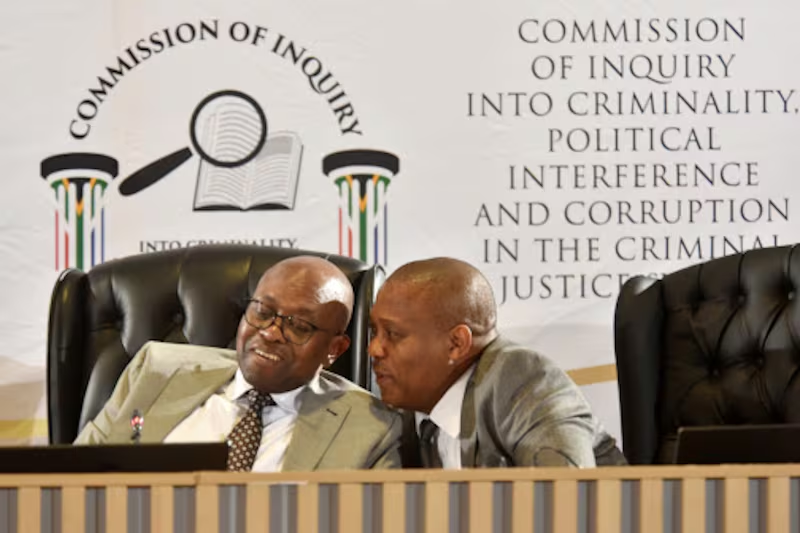
Observers described Mashazi’s appearance as tense and at times chaotic. At several points she was accused of offering dismissive or evasive responses — such as “I take your point”, “No comment”, or “I’ll talk to my lawyers.” On one occasion, she even joked that the intensity of the proceedings might give her a “stroke.” These responses did little to satisfy the commission, which repeatedly pressed her for documentary evidence in support of her claims.
Specifically, when she alleged systemic sexual harassment by the then head of the Ekurhuleni Metropolitan Police Department (EMPD), Jabulani Mapiyeye, she admitted she had received informal complaints from female officers. However, she conceded under oath that none of those complaints had been formalised or investigated — a failure that the commission’s Chair, Mbuyiseli Madlanga, strongly rebuked as “sitting back and folding her arms.”
The hearing also delved into alleged irregularities in internal disciplinary processes, particularly related to another suspended senior EMPD official, Julius Mkhwanazi. Mashazi denied shielding him from accountability, claiming that when formal investigation reports reached her office she referred them to the metro’s legal services. Yet the commission noted contradictions in her statements, including her earlier public remarks suggesting Mkhwanazi had been cleared.
Fallout and mounting criticism
The tone and content of Mashazi’s testimony triggered sharp reactions from both civil society figures and fellow commission participants. Critics accused her of abusing her former senior position to protect implicated officers. One prominent figure described her behaviour at the hearing as emblematic of “arrogance and cover-up.” Many have pointed out that for someone who once served as the city’s accounting officer, her inability to provide even basic documentary proof raises serious questions about administrative oversight and the culture of accountability in the metro.
Why the “prejudice” claim matters
Mashazi’s claim that she was prejudiced touches on a deeper issue: procedural fairness. If true, it suggests she was being compelled to comment on serious allegations without proper access to evidence or time to prepare — a potentially unfair test of her ability to defend herself. The supplementary affidavit she plans to submit could provide her with the opportunity to present documents and clarify her position, which may shift how her testimony is judged.
At the same time, the entire inquiry — of which Mashazi’s testimony forms a significant part — aims to uncover systemic corruption, political interference, and institutional failure within Ekurhuleni’s police apparatus. How the commission evaluates her supplement, and whether it accepts her evidence as credible, will influence not only her legacy but also the broader perception of municipal transparency and governance.
What comes next
Mashazi has until next Wednesday to submit her supplementary affidavit — a chance to fill gaps in her testimony with documentary backing. Meanwhile, the commission continues to scrutinise other high-profile figures implicated in broader allegations of corruption and institutional decay within the justice and policing systems.
For many South Africans watching closely, the coming days will show whether the Madlanga Commission’s process can meet the standards of fairness and rigour it promises — or whether procedural shortcomings will undermine its role in restoring public trust.