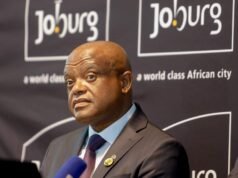
Senzo Mchunu, South Africa’s embattled Police Minister, is slated to appear before Madlanga Commission of Inquiry this week — the same commission where former Ekurhuleni city manager Imogen Mashazi has challenged the fairness of her own testimony. The commission is investigating deep-rooted allegations of political interference, corruption, and abuse of power within the police and justice system.
Mashazi says she was “prejudiced” under oath

Mashazi began her testimony before the commission on Monday and returned on Tuesday morning. According to her legal team, she was compelled to answer serious and complex allegations without having the relevant documentation on hand. Her attorney explained that she was placed in a difficult position — facing questions about sensitive matters while lacking full access to the evidence needed to respond properly. As a result, she requested, and was granted, time to furnish a supplementary affidavit. She now has until next Wednesday to supply documents and evidence supporting her responses.
Testimony marked by contradictions and failure to act
During her earlier days under oath, Mashazi was repeatedly pressed by commissioners to provide documentary proof for her claims and deny allegations. On a prominent matter under scrutiny, she acknowledged that she had received a complaint from an internal report by the Independent Police Investigative Directorate (IPID) accusing the former head of the Ekurhuleni Metropolitan Police Department (EMPD), Julius Mkhwanazi, of misconduct. Yet she admitted that she did not personally interrogate the report — she relied on legal advice and accepted that “there was no case.” Under further questioning, she conceded that she “may not have paid too much attention” to what she had read, and failed to initiate formal disciplinary action. In effect, as head of the city’s administration, she admitted she neglected her oversight responsibilities.
Multiple witnesses told the commission that Mashazi protected Mkhwanazi by blocking disciplinary processes and sidelining internal reports. And a video shown during proceedings made the relationship between the city manager and the EMPD chief more suspect: captured at what appears to have been a city-organised function, Mkhwanazi is seen declaring publicly, “We will die for you, I will take a bullet for you,” while Mashazi responds with a warm “Thank you.” The footage has been cited as evidence of personal loyalty overshadowing institutional accountability.
A backdrop of systemic failure — and the Task Team’s disbandment
All of this unfolds against the backdrop of a broader crisis: the controversial decision by Mchunu to disband the Political Killings Task Team (PKTT) — a specialised unit originally established in 2018 to combat politically motivated assassinations, particularly in KwaZulu-Natal. Former provincial police commander Nhlanhla Mkhwanazi told the commission that the disbandment — delivered just as the task team was closing in on powerful syndicates — halted critical investigations into cartel-linked political killings. He described the move as “irrational and irregular,” alleging that senior politicians and organised-crime networks exerted pressure to shut the unit down before exposure.
Witnesses for the state argue that the dissolution was not just a re-organisation: it was a deliberate strategy to protect vested interests. A former national police commissioner testified that the disbandment stripped the justice system of a key mechanism to hold powerful criminal and political actors accountable. Many now believe the move helped shield those implicated in ongoing murder and corruption cases.
What’s at stake — the credibility of the commission and institutional reform
Mchunu’s appearance this week marks a critical test for the Madlanga Commission. If he fails to offer a credible explanation for dissolving the Task Team — particularly amid credible allegations that it was about to crack high-profile syndicates — it could deepen public suspicion of political interference in policing. At the same time, whether Mashazi’s supplementary affidavit clarifies or further complicates her testimony will shape public trust in the Ekurhuleni municipality and broader police governance.
For civil-society activists, victims of political violence, and ordinary citizens alike, the stakes are high: a successful showing could reinstate confidence in institutional oversight; a failure may reinforce a narrative of systemic corruption, impunity, and erosion of the rule of law.
Read more: Mashazi Claims She Was Prejudiced During Her Testimony at the Madlanga Commission
Imogen Mashazi, the former City Manager of Ekurhuleni Metropolitan Municipality (EM), has told Madlanga Commission of Inquiry that she felt prejudiced during her testimony — a sentiment she says arose because she was asked to respond to serious allegations without having the relevant documents at hand.
Mashazi began her testimony on Monday. read more