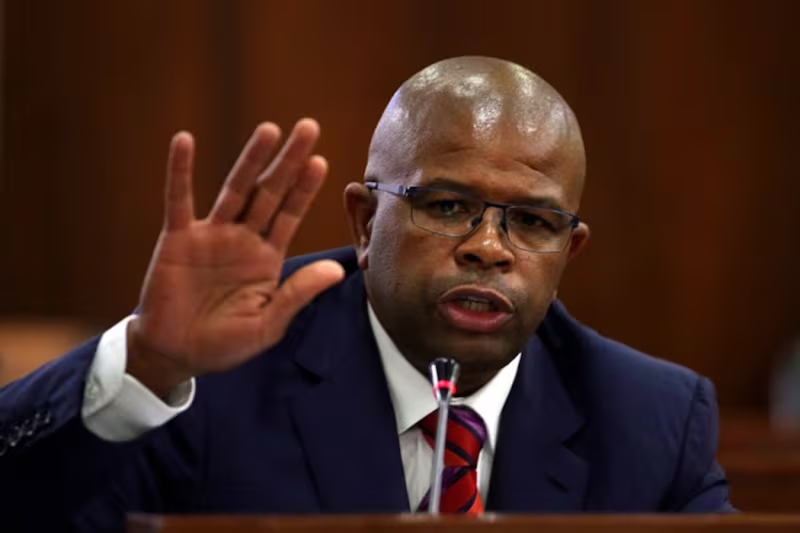
In a notable turn of events, Lucky Montana — the former CEO of the Passenger Rail Agency of South Africa (Prasa) — has officially stepped down as a Member of Parliament for the uMkhonto weSizwe Party (MKP).
Montana announced his decision on social media (X) on 1 December 2025, explaining that he had notified the MKP parliamentary leadership at the start of the year of his plan to resign. According to his post, he formally wrote to the party’s suspended deputy, John Hlophe, and Chief Whip Colleen Makhubela on 30 August 2025. “Today my resignation takes effect,” he stated.
The MKP confirmed acceptance of his resignation. Party spokesperson Nhlamulo Ndhlela praised Montana for his “steadfast objectivity, constructive guidance and principled contributions” that purportedly strengthened the party’s caucus and sharpened its political effectiveness.
The statement added that although he is leaving Parliament, Montana would remain “a committed member” of the party and continue in what the MKP described as “the struggle for the total emancipation of the black child.”
🧱 A Controversial Legacy
Montana’s departure from Parliament comes amid ongoing legal and financial turmoil. In late 2025, South African Revenue Service (SARS) secured a sequestration order against him, seeking to attach his assets to recover a tax debt of over R55 million accumulated between 2009 and 2019.
The Pretoria High Court dismissed Montana’s attempt to file an answering affidavit, meaning the sequestration process could proceed unchallenged. If enforced, this could impact his legal status and, by extension, any public office he holds.
Montana has publicly denied owing SARS a cent — calling the tax bill “insane” and framing the whole affair as a “politically motivated witch hunt.”
From Prasa to Parliament — and the Fallout
Montana’s political role with MKP followed his controversial tenure as CEO of Prasa (2010–2015), a time riddled with corruption allegations and inefficiencies. During his leadership, Prasa made a multi-billion-rand tender for new locomotives — a deal that ended up being highly problematic and resulting in massive losses.
As of August 2024, he became one of several former state‑owned enterprise executives tapped by MKP to occupy seats in Parliament, alongside other high‑profile figures.
In resigning, Montana joins a growing list of MKP lawmakers stepping down — just days after the party lost another MP, Duduzile Zuma-Sambudla, daughter of former president Jacob Zuma.
What’s Next — For the Party, For Montana
For MKP, Montana’s exit adds to a string of departures, complicating the young party’s parliamentary strategy and cohesion.
On the legal front, the asset‑seizure case remains live. If the court action proceeds, Montana could face insolvency — a status that legally bars a person from holding public office.
Politically, Montana insisted his resignation is not a retreat from public life. MKP says he will continue contributing to its aims outside Parliament.
Whether Montana will contest further legal or political battles — or quietly fade from the spotlight — remains to be seen. What’s clear is that his departure marks another turning point in the ongoing saga of state‑owned enterprise leadership, political accountability, and the shake‑ups within MKP.