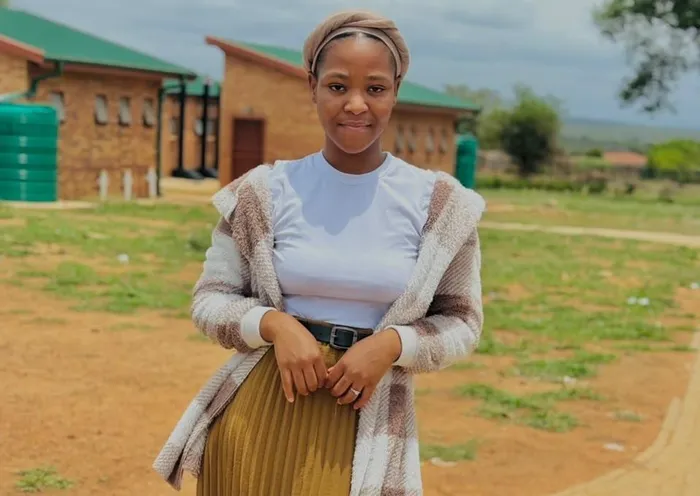
When Thuto Selomo received her student allowance, she was supposed to spend it on books and study materials for her law degree.
Instead, the 25-year-old from Ga-Mohokoni Village in Limpopo used the money to help feed children growing up in the same kind of poverty she knew as a child.
Today, Selomo runs the Thuto Selomo Organisation, a community drop-in centre providing a daily meal, a safe environment and support with schoolwork to about 60 children from disadvantaged families.
Her story is one of turning personal hardship into purpose — and demonstrating that community change does not always begin with large amounts of money.
From struggling for food to feeding children
Selomo grew up in difficult circumstances with her parents and two siblings.
Her father survived on temporary construction work while her mother was unemployed, leaving the family to navigate periods when even putting one meal on the table was a struggle.
There were nights when the family had little more than pap and milk.
Those experiences stayed with Selomo.
As she grew older, she began imagining what she would do if she ever had enough money to help families experiencing the same hardship.
“I always wished that if I had money, I would help those who were struggling like me to get food, especially kids,” she said.
Her childhood therefore became more than a memory. It became the foundation of the work she does today.
Inspired to help
Selomo said she was also inspired by the humanitarian work of the late Nigerian televangelist Temitope Balogun “TB” Joshua, whom she watched helping struggling communities and distributing food parcels.
She began her own community work on a smaller scale, providing items such as sanitary towels, school uniforms and shoes to people who needed them.
But she eventually realised that occasional donations were not enough.
Children in her community were dealing with a much more fundamental problem: hunger.
One experience particularly affected her.
She recalled seeing a child walking to school during winter wearing plastic sandals without socks.
“That’s where my calling began,” Selomo said.
She began thinking about creating a place where children could receive consistent support rather than relying on occasional acts of charity.
The birth of the Thuto Selomo Organisation
The Thuto Selomo Organisation was established as a drop-in centre in 2025.
Selomo said the organisation was registered with the Companies and Intellectual Property Commission and the provincial Department of Social Development.
The centre operates from Monday to Friday between 3pm and 5pm.
During those hours, children can receive a meal, spend time in a safe environment, play and get assistance with their schoolwork.
The initiative currently supports around 60 children between the ages of one and 17.
For some of the children, the centre provides much more than food.
Selomo says some come from households where parents are struggling with mental-health problems, while others have been forced to take on responsibilities normally associated with adults, including caring for younger siblings.
Some also lack basic necessities such as school uniforms.
“There are children who come to the centre wearing the same clothes and sometimes without having bathed,” she said.
The centre therefore aims to provide a place where children can feel cared for and protected while their families navigate difficult circumstances.
The R5,800 decision
Perhaps the most remarkable part of Selomo’s story is how she found the money to get the initiative started.
She used her NSFAS book allowance.
“I started the initiative with my NSFAS book allowance to fund the initiative,” she said.
Selomo received about R5,800, which was intended to help her purchase books and other learning materials for her studies.
Instead of spending all of it on herself, she used the money to buy items that would help launch her community initiative.
She said that when the allowance arrived around April or May, she would sometimes use some of the money to buy winter clothes.
Her decision highlights the personal sacrifices behind the centre’s existence.
It also comes with an important distinction: NSFAS allowances are intended to support students’ education and related needs, and students are expected to use funding in accordance with the applicable rules. NSFAS describes the learning-material allowance as support for study materials, while its broader funding package can include tuition, living and other allowances depending on the student’s circumstances.
For Selomo, however, the money became the seed funding for something she believed was urgently needed in her community.
Still studying law
Despite dedicating so much time and energy to vulnerable children, Selomo has not abandoned her own education.
She has been studying towards a Bachelor of Laws (LLB) through the University of South Africa since 2019 and is expected to graduate in 2027.
Her legal studies and community work now exist side by side.
The irony is not lost on her: while studying law to build a professional future, she is simultaneously running an organisation that addresses immediate social problems in her village.
Before establishing the centre, Selomo worked as an assistant teacher and used part of her income to support the initiative.
After she married in October 2025, her husband also became involved financially.
He contributes money from his employment, while donations from members of the public have provided additional support.
A community effort
Selomo runs the centre with her mother and another person.
Although resources remain limited, she says the response from the community has been encouraging.
Residents have seen the difference the centre makes and have supported its work through donations.
Social media has also helped bring attention to the initiative.
For Selomo, every donation is evidence that people recognise the needs of the children.
“When people recognise our work on social media and come forward to donate, it shows us that the centre is making a difference,” she said.
The support is particularly important because feeding 60 children every weekday requires a constant supply of food and other resources.
A centre serving children from vulnerable households also needs more than groceries. School supplies, clothing, hygiene products, educational materials and safe facilities can all make a difference.
Turning poverty into purpose
Selomo does not hide from her own history.
Instead, she regards it as one of the reasons she is able to understand what the children are experiencing.
She remembers what it felt like to worry about where the next meal would come from.
That memory helps her remain committed even when donations are scarce.
“It’s a calling,” she said.
Selomo believes her own experience of poverty has given her a responsibility to help children who are now facing similar circumstances.
Even during periods when the organisation receives little or no financial support, she says she does not consider giving up.
Her motivation comes from believing that her difficult childhood prepared her to recognise the needs of others.
Her dream goes beyond feeding
Providing meals is only the beginning of Selomo’s vision.
She ultimately wants to establish a home where vulnerable children can receive long-term care and support.
She is particularly concerned about children whose parents are struggling with mental-health challenges and those who are effectively left to fend for themselves.
“I want to provide a home for these children, not just food,” she said.
It is an ambitious goal, especially for a young woman still completing her own university degree.
But the organisation itself began with an idea, a modest amount of money and a willingness to start.
Selomo now hopes to build on that foundation.
“Just start”
For young South Africans who want to make a difference but believe they need substantial financial resources before they can begin, Selomo has a simple message.
Do not wait.
“If you have an idea or feel strongly about helping others, start now,” she said.
Her own journey demonstrates the principle.
She did not begin with a large building, a major donor or a substantial organisation.
She began with money intended for her own studies, a personal understanding of poverty and a desire to make sure children in her community did not go hungry.
Her advice is therefore straightforward: start with what you have.
“You do not have to wait until you have a lot of money. I started with my NSFAS book allowance, so my advice is simple — just start.”
For the children arriving at the Thuto Selomo Organisation each afternoon, that decision has already made a difference.
And for Selomo, the ultimate goal is not simply to serve another meal.
It is to create a place where children who have grown up surrounded by poverty can find food, safety, dignity, education and hope.