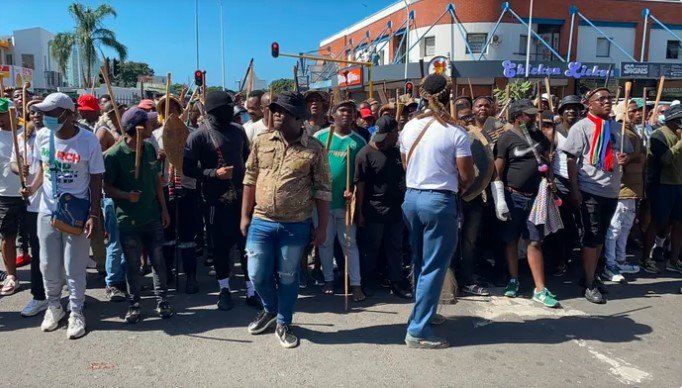
Hundreds of residents in Daveyton, east of Johannesburg, took to the streets on Saturday in a protest against undocumented immigration, joining a growing movement that has gained momentum in several communities across Gauteng in recent months.
The demonstration, organised under the banner of the “Mabahambe” campaign — a phrase commonly interpreted as “they must go” — brought together residents who say they are increasingly concerned about unemployment, crime, housing shortages and mounting pressure on already overstretched public services.
Protesters gathered early in the day before marching through sections of the township, carrying placards and chanting slogans calling for stronger border controls, stricter immigration enforcement and greater prioritisation of South African citizens in employment opportunities.
The march remained largely peaceful, with organisers insisting that their objective was to draw attention to what they described as the worsening socio-economic conditions facing many local communities. Participants argued that competition for jobs, access to healthcare, social services and housing has intensified as economic conditions continue to deteriorate.
Several residents who joined the demonstration said they felt government had failed to adequately address concerns around undocumented migration and border security. Many expressed frustration over high unemployment levels, particularly among young people, and claimed that local businesses should prioritise hiring South African citizens before recruiting foreign nationals.
Organisers said the protest was intended to provide a platform for residents to voice concerns that they believe have gone unanswered for years. They also planned to submit a memorandum of demands to local authorities, outlining their grievances and calling for immediate intervention from government.
Growing National Debate
The Daveyton protest is the latest in a series of demonstrations that have taken place across parts of Gauteng and other provinces, reflecting a broader national debate around immigration, border management and economic opportunity.
South Africa continues to attract migrants from across the African continent due to its relatively developed economy and employment prospects compared to many neighbouring countries. However, the country also faces significant domestic challenges, including persistently high unemployment, rising living costs and slow economic growth.
These pressures have contributed to increasing tensions in some communities, where residents argue that scarce resources are being stretched beyond capacity. Concerns are often raised regarding access to housing, healthcare facilities, schools and municipal services, particularly in densely populated urban areas.
At the same time, migration experts and human rights organisations have repeatedly warned against linking social and economic challenges solely to foreign nationals, arguing that broader structural issues, governance failures and economic conditions play a significant role in the difficulties faced by communities.
Police Presence and Security Measures
Law enforcement agencies maintained a visible presence throughout the protest, with police officers deployed across key areas of Daveyton and neighbouring Benoni to monitor developments and ensure public safety.
Authorities have consistently emphasised that while citizens have a constitutional right to protest, demonstrations must remain peaceful and comply with legal requirements. Police have also warned against vigilantism, intimidation and acts of violence directed at individuals based on their nationality or immigration status.
Officials closely monitored the march amid concerns that similar demonstrations elsewhere in the country have occasionally escalated into confrontations between residents, foreign nationals and law enforcement authorities.
Fortunately, no major incidents were reported during Saturday’s protest, and the demonstration concluded without significant disruption to businesses or public transport services in the area.
Calls for Government Action
Among the key demands raised by protesters were stronger border security measures, more effective documentation systems, stricter enforcement against undocumented immigrants and greater support for unemployed South Africans.
Some participants also called for increased inspections of businesses suspected of employing undocumented workers, arguing that labour regulations should be more rigorously enforced.
Community leaders involved in the march said their concerns should not be interpreted as hostility towards all foreign nationals but rather as a call for government to manage immigration more effectively and ensure compliance with existing laws.
The issue remains politically sensitive, particularly as South Africa continues to grapple with record unemployment levels and growing public dissatisfaction over service delivery and economic opportunities.
Wider Implications
The Daveyton demonstration highlights the increasingly complex relationship between migration, economic hardship and public sentiment in South Africa. As communities continue to face challenges linked to unemployment, poverty and inequality, immigration has become a focal point in broader debates about resource allocation and government accountability.
Analysts note that addressing these concerns will require a balanced approach that strengthens border management and law enforcement while also tackling the root causes of unemployment, poor service delivery and economic stagnation.
As the memorandum submitted by protesters moves through municipal channels for consideration, residents say they will continue pressing authorities for answers and action. Whether government responds with new policy measures or improved enforcement remains to be seen, but the demonstration has once again underscored the depth of frustration being felt in many communities across the country.
With similar protests emerging in other parts of Gauteng, the issue of immigration is likely to remain a prominent topic in public discourse, placing increasing pressure on policymakers to find solutions that address both community concerns and South Africa’s legal and humanitarian obligations.