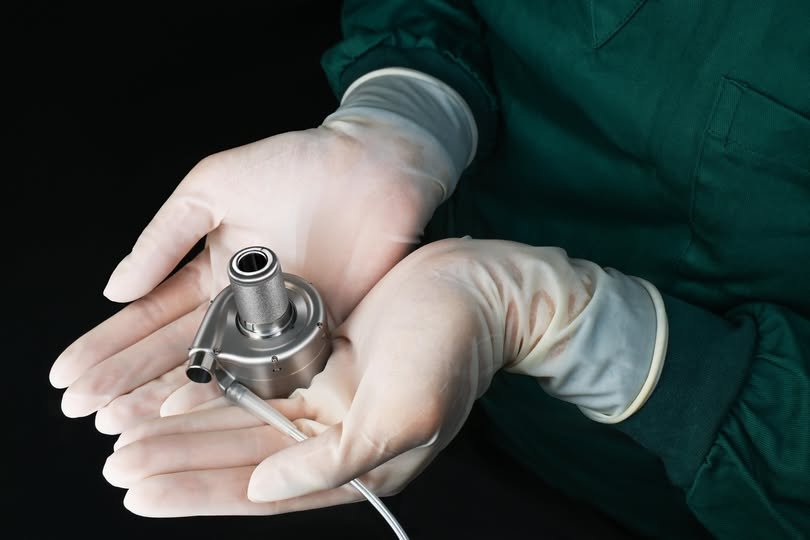
A groundbreaking artificial heart developed in China is attracting international attention after being successfully implanted in Europe, marking another major milestone in the country’s growing medical technology sector.
The device, known as BrioVAD, is a fully magnetically levitated artificial heart designed to support patients living with end-stage heart failure. Roughly the size of a table tennis ball, the compact mechanical pump is engineered to replace the function of a failing left ventricle, helping circulate blood throughout the body while patients await a heart transplant or, in some cases, as a long-term treatment.
Developed by Suzhou-based BrioHealth Solutions, the artificial heart represents years of research and collaboration involving scientists, engineers, hospitals, universities and government institutions.
A Smaller Device With Bigger Potential
Unlike many conventional ventricular assist devices, BrioVAD uses a fully magnetic levitation system that allows its internal rotor to spin without making physical contact with surrounding components.
This friction-free design reduces wear and tear, lowers heat generation and minimises damage to blood cells, helping decrease the risk of complications such as blood clots and strokes.
Engineers achieved this by separating the motor from the magnetic levitation unit, allowing for a larger rotor while reducing the device’s operating speed. The result is a smaller implant that offers improved blood compatibility and greater long-term durability.
Since its development, the device has undergone extensive laboratory testing, simulating billions of heartbeats while operating continuously to demonstrate its reliability.
Expanding Beyond China
After receiving approval to begin clinical trials in the United States, BrioVAD has continued its international expansion.
On June 2, surgeons at the University Medical Center Utrecht in the Netherlands successfully implanted the device into a patient, marking its first use in Europe and an important step toward broader international adoption.
The procedure follows growing interest from hospitals worldwide as demand increases for advanced treatments for severe heart failure.
Addressing a Global Health Challenge
Heart failure remains one of the world’s leading causes of illness and death, affecting tens of millions of people globally.
In China alone, an estimated 13.7 million adults over the age of 35 live with heart failure, including more than one million people with end-stage disease.
While heart transplantation remains the gold standard treatment for advanced heart failure, the shortage of donor organs means only a small proportion of eligible patients receive transplants each year. This gap has driven increased investment in artificial heart technologies capable of supporting patients for months or even years.
From Research Vision to Medical Breakthrough
The development of BrioVAD is closely linked to the work of biomedical engineer Chen Chen.
In the early 2000s, Chen led a research team in the United States that developed Levacor, one of the first fully magnetically levitated artificial hearts to enter U.S. clinical trials. Although the device ultimately failed to achieve commercial success because of its size and implantation challenges, the experience reinforced Chen’s belief that magnetic levitation represented the future of artificial heart technology.
After returning to China, Chen established his research efforts in Suzhou and pursued the more technically demanding magnetic levitation approach at a time when most developers were focusing on hydrodynamic suspension systems.
His proposal, presented to leading medical and scientific experts in 2009, laid the foundation for what would eventually become BrioVAD.
Years of Progress
The technology advanced steadily over the following decade.
In 2017, BrioHealth Solutions implanted its artificial heart into a critically ill patient for the first time, demonstrating that the technology was ready for clinical use.
Since then, the company’s devices have been implanted in more than 1,000 patients, providing life-saving support for individuals with advanced heart failure.
Breaking New Ground in the United States
BrioVAD reached another historic milestone in February 2024 after receiving approval from the U.S. Food and Drug Administration to begin clinical trials.
The approval made it the first active implantable medical device developed in China to enter U.S. clinical trials.
Later that year, surgeons at Emory University Hospital performed the first BrioVAD implantation in the United States.
By April 2026, more than three-quarters of the top 30 U.S. hospitals performing artificial heart implant procedures had joined the clinical trial programme, highlighting growing confidence in the technology among leading cardiovascular specialists.
The Future of Artificial Hearts
Artificial hearts and ventricular assist devices are increasingly viewed as one of the most promising solutions to the global shortage of donor organs. Advances in magnetic levitation technology have improved the safety, durability and effectiveness of these devices, allowing patients to enjoy better quality of life while awaiting transplantation or as long-term therapy.
As BrioVAD continues to expand into international markets, its success reflects not only China’s growing capabilities in high-end medical technology but also the rapid evolution of artificial heart systems that could transform treatment for millions of people living with severe heart disease worldwide.