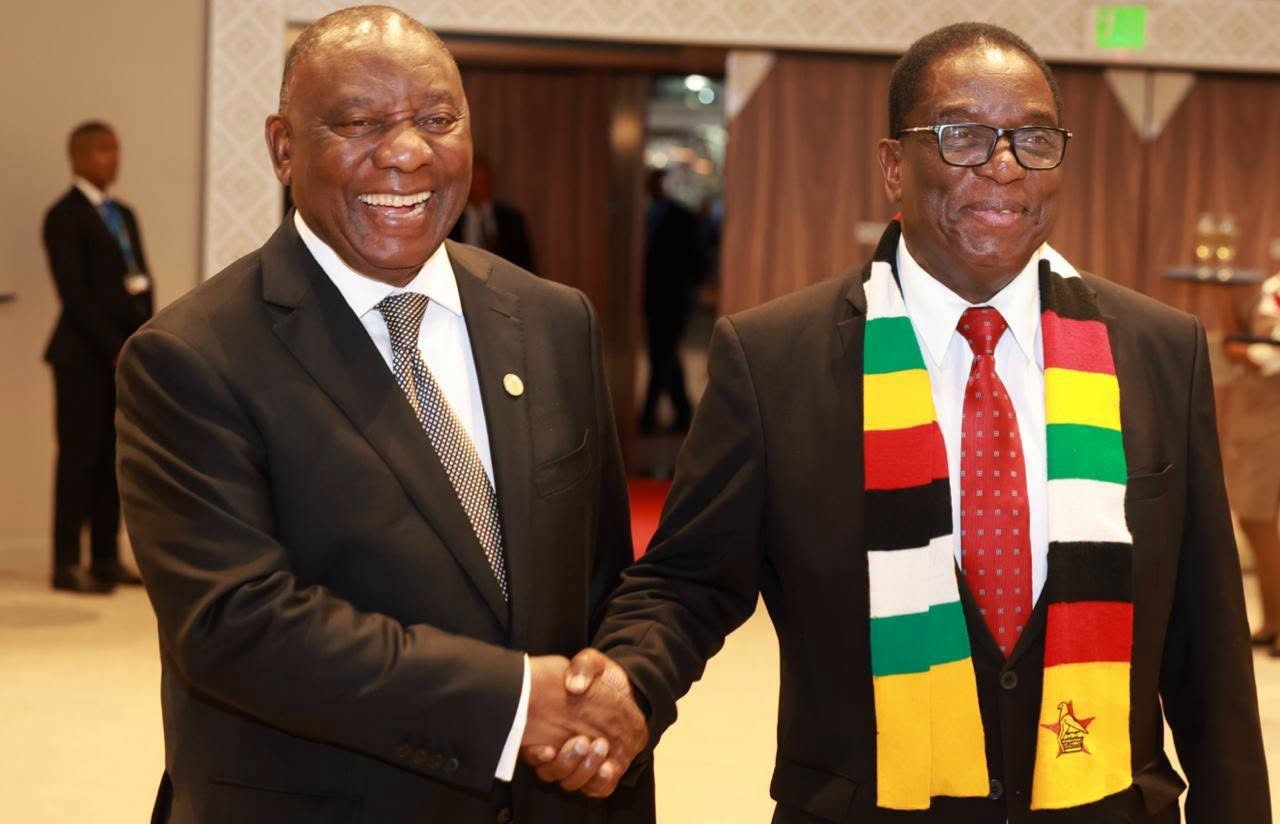
DURBAN, South Africa — President Cyril Ramaphosa has outlined an ambitious agenda for South Africa’s year at the helm of the Southern African Development Community, placing regional integration, industrialisation, trade, infrastructure and economic transformation at the centre of the country’s chairpersonship.
Ramaphosa formally accepted the SADC chairpersonship at the bloc’s 46th Ordinary Summit in Durban on Monday, pledging that South Africa would approach the responsibility with humility and in a spirit of cooperation with all member states.
The summit brings together leaders from SADC’s 16 member countries as the region seeks to accelerate economic integration while confronting challenges around security, food security, infrastructure, energy and slow intra-regional trade.
Accepting the chairpersonship, Ramaphosa said South Africa viewed the position not simply as an honour, but as a responsibility entrusted to it by the people of Southern Africa.
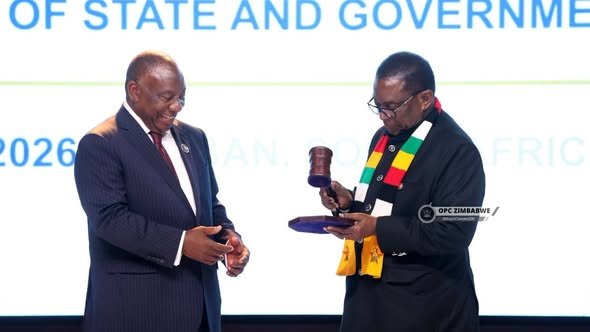
“On behalf of the Government and the people of South Africa, I accept the responsibility of assuming the Chairpersonship of SADC,” he said.
He added that South Africa would build on the work of previous chairs and focus on turning regional commitments into tangible improvements for citizens.
Integration at the heart of South Africa’s agenda
One of the central priorities of South Africa’s chairpersonship will be accelerating regional integration.
Ramaphosa said SADC needed to make it easier for goods, services, capital and skills to move between member states, arguing that stronger economic links would create a larger and more competitive regional market.
“We must deepen regional integration so that goods, services, capital, skills can move more efficiently across our borders,” he said.
The emphasis comes as SADC continues to face barriers that limit the potential of its regional market, including inefficient border processes, infrastructure constraints, differing regulations and other obstacles to cross-border trade.
South Africa is expected to push for stronger implementation of existing regional agreements rather than simply creating new commitments.
The broader objective is aligned with SADC Vision 2050, which envisages a peaceful, inclusive and competitive industrialised region supported by deeper market integration, infrastructure development and investment in human capital.
Trade and regional value chains
Another major focus will be expanding trade between SADC countries.
While intra-regional trade has improved in recent years, it remains relatively modest compared with the region’s trade with markets outside SADC. This has reinforced calls for member states to remove trade barriers and strengthen regional supply chains.
Ramaphosa said South Africa would seek to strengthen regional value chains and increase intra-African trade while attracting investment into infrastructure that can support greater economic activity.
The strategy is particularly important for industries such as mining, agriculture, manufacturing and energy, where SADC countries possess resources and markets that could be linked more effectively.
Rather than exporting raw materials and importing finished products, regional governments increasingly want to develop industries that process resources locally, create jobs and retain more value within Southern Africa.
Industrialisation takes centre stage
Industrialisation is another defining feature of South Africa’s SADC programme.
The 46th summit is being held under a theme focused on resilient, sustainable and inclusive industrialisation through infrastructure development, agricultural transformation and the development of critical minerals.
For South Africa, the agenda creates an opportunity to use its industrial base, financial institutions and infrastructure capabilities to support greater economic integration across the region.
Ramaphosa said member states would work together to advance industrialisation and ensure that young people, women and entrepreneurs are central to the region’s economic transformation.
“We will do everything to work together to advance the industrialisation agenda, and we will place young people, women, entrepreneurs at the centre of our region’s economic transformation,” he said.
The focus on critical minerals is particularly significant as countries around the world compete for minerals needed for renewable energy, electric vehicles, advanced manufacturing and other technologies.
SADC countries possess substantial mineral resources, but much of the region’s economic potential remains tied to the export of commodities rather than higher-value processing and manufacturing.
A stronger regional industrial strategy could allow countries to collaborate on mining, processing, manufacturing, transport and energy rather than competing primarily as exporters of raw materials.
Infrastructure seen as key to growth
Ramaphosa’s economic agenda also places infrastructure investment at the centre of regional integration.
Better roads, railways, ports, electricity networks and digital infrastructure are essential if SADC wants to increase trade and make cross-border supply chains more competitive.
The issue is particularly important for landlocked member states, whose economies depend heavily on transport corridors connecting them to ports and international markets.
South Africa’s chairpersonship is therefore expected to place greater emphasis on regional infrastructure projects and the mobilisation of investment to support them.
The availability of reliable energy will also be critical to industrialisation. Manufacturing, mining and agriculture all require dependable electricity, while regional energy cooperation could help countries manage shortages and improve resilience.
Agriculture and food security
Agriculture will form another important part of the regional agenda.
SADC has faced recurring droughts, floods and other climate-related shocks that have placed pressure on food production and household livelihoods.
The summit’s focus on agricultural transformation reflects growing recognition that food security cannot be treated purely as a national issue.
Greater regional cooperation could involve strengthening agricultural supply chains, improving access to inputs and markets, investing in irrigation and supporting climate-resilient farming.
For South Africa and its neighbours, stronger agricultural integration could also reduce vulnerability to food shortages and external supply disruptions.
Jobs, young people and entrepreneurs
Ramaphosa has repeatedly linked regional economic integration to employment creation.
For the SADC agenda to succeed politically, governments will need to demonstrate that industrialisation and trade produce practical benefits for ordinary citizens.
That means creating opportunities for young people, supporting small and emerging businesses and ensuring women are able to participate more fully in regional economies.
South Africa’s chairpersonship will therefore seek to place entrepreneurship and youth participation alongside large infrastructure and industrial projects.
The challenge will be turning regional strategies into actual businesses, jobs and investment opportunities.
Peace and security remain essential
While economic development will feature prominently, Ramaphosa stressed that SADC’s economic ambitions cannot be separated from peace and security.
Political instability and conflict can disrupt trade, discourage investment and undermine development programmes.
The region continues to deal with complex political and security challenges, making the SADC Organ on Politics, Defence and Security Cooperation an important component of the bloc’s work.
Ramaphosa said South Africa would seek to safeguard peace, security, democracy and stability alongside its economic priorities.
“The strength of SADC lies not only in its institutions or its agreements, but it lies in the solidarity of its member states,” he said.
That approach is consistent with SADC’s broader Vision 2050, which places peace, security and good governance at the foundation of its long-term economic and social objectives.
South Africa’s chairpersonship rooted in liberation history
Ramaphosa also used his acceptance speech to reflect on the historical ties between South Africa and the rest of Southern Africa.
During apartheid, neighbouring countries provided shelter and support to South African liberation movements despite facing economic and military pressure from the apartheid government.
Ramaphosa said that history had shaped South Africa’s relationship with the region and influenced how the country approached its responsibilities within SADC.
“Our participation in SADC is founded upon this history of courage, sacrifice and solidarity,” he said.
He pledged that South Africa would work with member states on the principles of sovereign equality, mutual respect, solidarity and consensus.
Building on Zimbabwe’s leadership
Ramaphosa thanked outgoing chairperson President Emmerson Mnangagwa for Zimbabwe’s leadership of SADC and said South Africa would build on the foundation laid during Zimbabwe’s tenure.
He also congratulated Zimbabwe on securing a non-permanent seat on the United Nations Security Council, saying the country would represent both SADC and the wider African continent in the international body.
South Africa’s assumption of the chairpersonship comes after it had already taken on an interim leadership role in late 2025 following political developments in Madagascar that resulted in the country relinquishing the SADC chair.
The formal handover at the Durban summit now gives South Africa a full year to drive its priorities.
Turning promises into results
The biggest test of South Africa’s chairpersonship will be implementation.
SADC has adopted ambitious long-term plans before, but regional integration has often been slowed by differences between member states, limited funding, infrastructure bottlenecks and uneven implementation of agreements.
The regional bloc has been working on the operationalisation of a SADC Regional Development Fund intended to help finance development projects and programmes, potentially providing an important mechanism for turning regional plans into infrastructure and industrial projects.
For South Africa, the challenge will be to use its influence as chair to encourage member states to move beyond declarations and accelerate implementation.
Ramaphosa acknowledged this responsibility, saying South Africa would act “as a servant of the region” and would listen, consult and seek consensus.
“Above all, we will work with every member state to translate our shared commitments into visible and lasting progress,” he said.
As South Africa begins its tenure, the priorities are therefore clear: deepen regional integration, increase trade, strengthen infrastructure, advance industrialisation, add value to the region’s natural resources, improve food security and create opportunities for young people, women and entrepreneurs.
The success of the chairpersonship, however, will ultimately be measured not by the number of agreements reached, but by whether those commitments translate into faster trade, greater investment, stronger regional industries and improved economic opportunities for the people of Southern Africa.