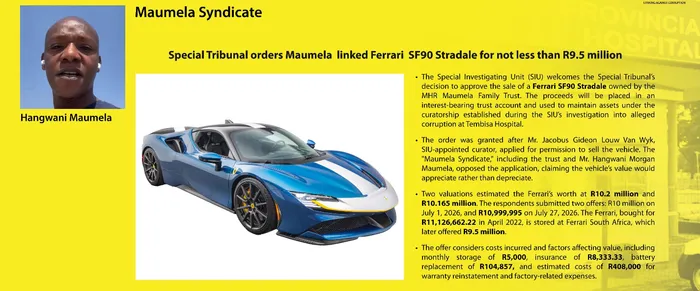
The Special Tribunal has authorised the sale of a Ferrari SF90 Stradale valued at more than R10 million, an asset linked to businessman Hangwani Morgan Maumela and the Special Investigating Unit’s investigation into alleged procurement fraud at Tembisa Hospital.
The ruling clears the way for curator Jacobus Gideon Louw van Wyk to sell the high-performance vehicle while the broader legal proceedings remain unresolved.
The Ferrari is among a collection of luxury assets that authorities have sought to preserve as they investigate allegations that companies linked to Maumela benefited improperly from government contracts at Tembisa Hospital.
The tribunal’s decision followed an application by the curator, who argued that keeping the vehicle in storage was unnecessarily expensive and that the proceeds could be invested in a way that better protected the value of the restrained estate.
Court rejects attempt to block the sale
Tribunal president Judge Bernard Makgabo Ngoepe dismissed opposition to the sale from Maumela, his associates and his mother, Mboneni Benedicta Maumela, a former senior Limpopo Department of Health official.
The respondents argued that the Ferrari belonged to the MHR Maumela Family Trust and that the trust’s consent was therefore required before it could be sold.
They also disputed the curator’s argument that the vehicle was depreciating rapidly, contending that the Ferrari was instead capable of appreciating in value.
Ngoepe rejected the arguments after examining the evidence surrounding the vehicle’s ownership.
A key issue was the uncertainty over who actually owned the Ferrari.
The curator had repeatedly sought documentation establishing the vehicle’s ownership. He was initially told that Drive Time Auto CC owned it, a position that was supported by the respondents.
However, Drive Time subsequently confirmed on three separate occasions that it had no ownership rights or interest in the Ferrari.
The tribunal also found that the Family Trust had registered the vehicle in its name shortly before the sale application was launched, without informing the curator.
That registration took place despite a preservation order prohibiting the transfer of the Ferrari to another entity, including the trust.
Ngoepe described the registration as a “stratagem” intended to frustrate the sale and concluded that the respondents had acted in bad faith.
Ferrari costs more to keep than to preserve
The court did not ultimately accept that the Ferrari was rapidly losing its market value.
Independent valuations placed the vehicle’s value at slightly more than R10.1 million, while offers received for it ranged from approximately R10 million to almost R11 million.
The Ferrari had originally been purchased for about R11.13 million in April 2022.
While it had lost some value since then, the tribunal found that the decline was not sufficiently rapid to justify the curator’s original argument on depreciation.
The deciding issue was the continuing cost of keeping the vehicle.
Evidence before the tribunal showed that insurance alone cost about R100,000 a year, while storage was approximately R5,000 a month.
Reinstating the Ferrari’s warranty would cost an estimated R408,000.
Ngoepe concluded that these expenses represented an unnecessary drain on the restrained estate.
Rather than continuing to pay to store and maintain a luxury vehicle that was not being used, the proceeds could be placed in an interest-bearing account and generate a return.
Ferrari may not be sold for less than R9.5 million
The tribunal authorised the curator to sell the Ferrari for no less than R9.5 million.
The proceeds must be deposited into a special interest-bearing trust account.
The money may only be used to maintain assets under curatorship with the approval of the SIU, while the proceeds cannot be used to pay the curator’s fees.
The conditions are designed to ensure that the value represented by the Ferrari remains protected while the underlying legal dispute continues.
The sale therefore does not amount to a final determination that Maumela committed fraud or that the vehicle constitutes the proceeds of crime. Those broader allegations remain subject to legal proceedings.
Part of a much larger asset investigation
The Ferrari forms part of a much wider preservation effort involving properties, vehicles and other assets allegedly connected to the Maumela network.
The SIU has described Maumela as one of the individuals at the centre of its investigation into alleged fraudulent dealings involving Tembisa Hospital.
In June, the SIU also moved against a luxury vehicle dealership in Mpumalanga after a Bentley linked to Maumela was allegedly found at the premises.
The authorities have been tracing ownership chains involving several luxury vehicles as they attempt to determine whether assets were acquired using proceeds allegedly generated through irregular government contracts.
The preservation order granted in August 2025 covers a substantial collection of luxury property and vehicles.
Among the properties are high-value homes and estates in areas including Bantry Bay, Sandhurst, Hartbeespoort, Ballito and Three Anchor Bay.
The vehicles include several exotic and high-performance models, among them Lamborghini Urus, Huracán STO, Aventador SVJ and Aventador Ultimae models, as well as a Bentley Continental GT V8.
A luxury boat and a multipurpose trailer are also included in the asset pool.
The scale of the assets has become one of the most visible aspects of the investigation, with authorities seeking to prevent potentially recoverable property from being sold, transferred or otherwise dissipated while the legal process continues.
The Tembisa Hospital investigation
The investigation has its origins in concerns raised about procurement at Tembisa Provincial Tertiary Hospital.
The case gained national attention after the work of Babita Deokaran, a senior Gauteng Department of Health finance official who identified suspicious transactions involving the hospital.
Deokaran was assassinated outside her home in August 2021.
Her disclosures helped trigger a broader examination of the hospital’s procurement and payment systems, with investigators scrutinising supplier registrations, payments, company ownership structures and transactions spanning several years.
The investigation was supported by the National Treasury’s specialised audit services.
Investigators subsequently identified a network of companies allegedly linked to Maumela and concluded that the businesses had benefited from hospital contracts worth more than R400 million.
The SIU has separately described the wider fraud allegations at Tembisa Hospital as involving billions of rand in questionable dealings.
Alleged manipulation of procurement processes
The forensic investigation uncovered allegations of widespread manipulation of procurement procedures.
Investigators allege that tender processes were structured to favour companies linked to the suspected network.
In some cases, businesses that appeared in procurement documentation as competing bidders allegedly denied submitting quotations at all.
Authorities also identified what they described as cover-quoting arrangements, in which additional companies allegedly submitted quotations to create the appearance of genuine competition while the preferred supplier was positioned to secure the contract.
Such practices, if proven, would undermine the competitive bidding process by creating the appearance of compliance while allegedly predetermining the successful bidder.
Investigators also traced financial transactions associated with the companies and identified spending on luxury properties, vehicles and other high-value assets.
Authorities allege that some of the money was also used to make improper payments to officials and other participants in the procurement process.
These remain allegations and must ultimately be tested through the criminal and civil proceedings arising from the investigation.
Luxury assets under the microscope
The Ferrari ruling highlights an increasingly important element of South Africa’s fight against corruption: recovering assets allegedly purchased with the proceeds of unlawful government contracts.
Instead of waiting for criminal proceedings to conclude before attempting to secure potentially recoverable property, the SIU can seek preservation orders through the Special Tribunal.
Such orders are intended to prevent assets from being transferred or dissipated while recovery proceedings are under way.
The Ferrari case demonstrates the practical challenges that can arise once an asset is restrained.
A luxury vehicle can cost substantial amounts to insure, store and maintain, meaning that simply preserving the physical asset may itself reduce the value of an estate.
The tribunal’s solution was therefore to convert the Ferrari into cash and preserve the proceeds under strict conditions.
A significant ruling for the SIU
The decision strengthens the SIU’s efforts to preserve and ultimately recover assets allegedly linked to the Tembisa Hospital procurement scandal.
It also sends a clear message about attempts to manipulate ownership structures after preservation orders have been issued.
Ngoepe’s finding that the transfer into the Family Trust was a deliberate stratagem was particularly significant because ownership disputes can complicate efforts to recover assets allegedly obtained through unlawful conduct.
For the curator, the ruling removes the immediate financial burden of keeping the Ferrari in storage while ensuring that the proceeds remain protected.
For the Maumela family and other respondents, however, the wider legal battle is far from over.
The Ferrari sale is one step in a much larger process involving the alleged diversion of public funds, disputed procurement practices and the tracing of assets said to have been acquired from those proceeds.
The Ferrari may soon disappear from the list of restrained physical assets, but the money generated by its sale will remain under court-supervised protection until the underlying proceedings are resolved.
The case ultimately reflects the broader objective of the Tembisa Hospital investigation: to determine whether public funds were unlawfully diverted and, where wrongdoing is established, to recover assets allegedly purchased with the proceeds.